
Sandton Drive is about to become a downhill engineering experiment, and on Sunday, 4 October, Johannesburg gets to watch it happen.
Motorsport events are built around horsepower, sophisticated machinery, and precision engineering. Then there is the Red Bull Box Cart Race. Here, the engine is gravity. The machines are handmade. The fuel is imagination. And once the cart is released at the top of Sandton Drive, there is only one real question: can the team keep it pointed in the right direction long enough to reach the finish?

Red Bull Box Cart Race returns to Johannesburg on Sunday, 4 October 2026, at 11 Sandton Drive. The event begins at 11:00, is free for spectators and brings together teams whose homemade machines have been designed to tackle a downhill course packed with jumps and obstacles.
For ESA, this is more than another spectacle. It is an action-sports story built around speed, risk management, creativity, mechanical problem-solving and the unpredictable relationship between humans and gravity.
The machine is the star
Forget the showroom. These aren’t production vehicles, and they aren’t supposed to be. Red Bull’s rules require teams to build human-powered, non-motorised machines. Engines, petrol, batteries, electrical cords, catapults and other external sources of propulsion are prohibited. Gravity provides the power. Steering and functional brakes are mandatory.
The dimensions are restricted too: a maximum length of 6 metres, a width of 2 metres, and a height of 2.5 metres, with the cart limited to 80kg excluding the driver. That changes the engineering problem completely. The teams are not trying to create the most powerful vehicle. They are trying to extract useful speed from a machine that has no engine, while keeping enough control to negotiate the course.
Every design decision matters. Weight. Balance. Steering. Braking. Aerodynamics. Wheel placement. Driver position. And, eventually, what happens when all of that meets a jump.
Speed is only part of the equation
The obvious objective is to get down the hill quickly. But Red Bull’s judging system also considers creativity and showmanship, meaning the competition operates somewhere between motorsport, engineering, performance art and street spectacle.

Teams can have a machine that looks outrageous, but if it cannot stay under control, the concept means very little once the wheels leave the start line. That tension is what makes Box Cart interesting from an action-sports perspective. Preparation happens in the workshop. The test comes on the hill. And the final result is often decided in seconds.
Sandton Drive becomes the course
Johannesburg last hosted the race on Sandton Drive in 2018. Eight years later, the event returns to the same location. This is not a conventional closed-circuit race. The environment becomes part of the challenge.
The course incorporates jumps and obstacles, while the gradient provides the acceleration. That means drivers have to deal with changing speed, steering inputs, braking points, and the consequences of getting a line wrong. There is very little room for recovery once momentum takes over. And that is where the action begins.
From Cape Town champions to Joburg challengers
South Africa’s Box Cart history stretches back to 2004, when the first local edition was held in Durban. The event has subsequently travelled through Johannesburg, Soweto, Sandton and Cape Town. South Africa remains the only African country to have hosted the event, with the 2026 race marking the eighth South African edition.
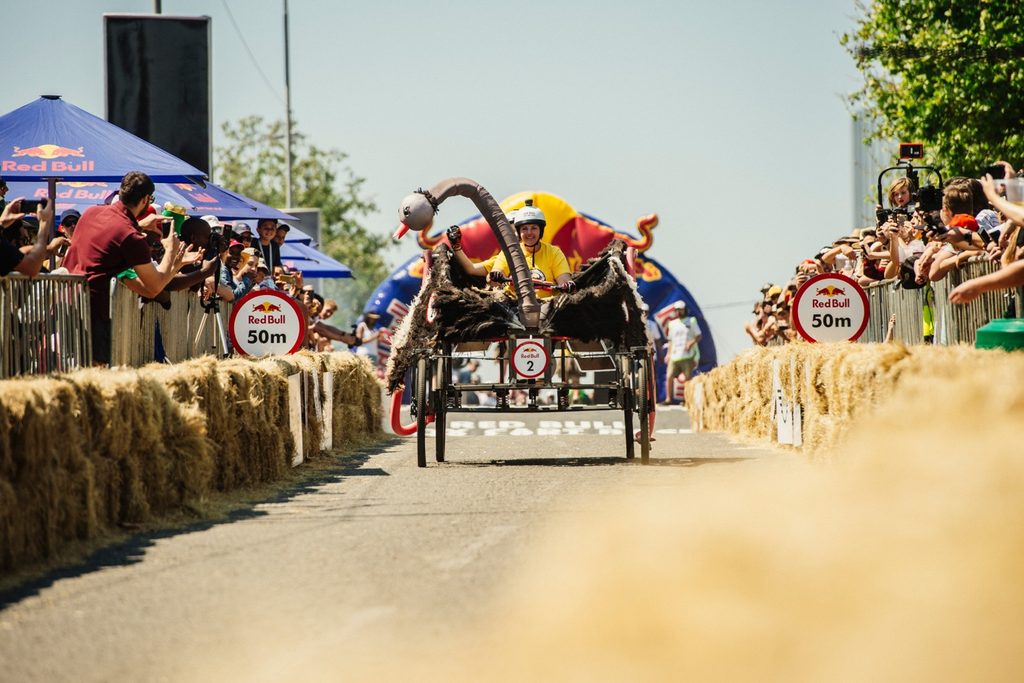
The Potjie Boytjies from Stellenbosch arrive as the reigning champions after winning the Cape Town editions with their potjie-pot-inspired machine. Their cart turned a distinctly South African cultural reference into a functioning downhill machine and proved that the concept behind a cart can matter almost as much as its construction.
Now the hill belongs to Joburg.
Engineering meets theatre
One of the unusual elements of the Box Cart Race happens before the race itself. Teams perform a skit at the start line, giving the judges and spectators an introduction to their concept before the cart begins its descent. That makes the event fundamentally different from a conventional engineering competition. The machine has to work. But the team also has to communicate an idea.
This year’s field includes Noma Yini and Kwik Kwik Nawu Nawu, among the teams bringing their own concepts to Sandton Drive. Kwik Kwik Nawu Nawu is made up of final-year UCT Mechanical Engineering students whose cart is built around a delivery theme.
So there is an interesting divide running through the field: practical engineering on one side, imagination and entertainment on the other.
The teams need both.
The wipeout is part of the story, but control matters
A wipeout might produce the biggest photograph of the day, but the spectacle begins with controlled risk. Drivers must wear helmets, and the rules require functional steering and braking systems. Drivers and co-drivers must also wear full-length trousers, long-sleeved tops, closed shoes and gloves.
The course is deliberately challenging, but the objective remains getting the machine across the finish line. That distinction matters. The fastest run means very little if the cart does not finish.
Johannesburg’s downhill laboratory
The appeal of Red Bull Box Cart Race is ultimately very simple. Give people a hill. Remove the engine. Give them a set of rules. Then see what they build. The result is part engineering challenge, part action spectacle, and part cultural theatre.

For spectators, it means watching machines that may have spent weeks being designed, fabricated and decorated get reduced to one short test against gravity.
For the teams, it is the opposite. Everything comes down to that run. The design. The build. The calculations. The rehearsals. The driver. The brakes. The steering. The nerve.
Then the release.
EVENT DETAILS
Red Bull Box Cart Race South Africa Joburg 2026
Date: Sunday, 4 October 2026
Time: From 11:00 SAST
Location: 11 Sandton Drive, Sandton, Johannesburg
Entry: Free for spectators
Format: Handmade, gravity-powered downhill carts
ESA angle: Action sport | Engineering | Speed | Risk | Innovation | Motorsport culture
The event is scheduled to run through the afternoon, with activities expected to conclude by 18:00. There are also temporary road closures around Sandton Drive, Grayston Drive, Alice Lane and 5th Street associated with the event build, race and breakdown period.
Official Red Bull Box Cart Race Johannesburg 2026 event information
ESA VERDICT: WATCH THE ENGINEERING, NOT JUST THE WIPEOUTS
Red Bull Box Cart Race works because it turns a basic physical principle into an extreme creative challenge. Gravity supplies the energy. Humans supply the ideas. The course exposes the weaknesses. And the finish line tells you whether the machine actually worked.
On 4 October, Sandton Drive becomes the laboratory.
The experiments will be rolling downhill.